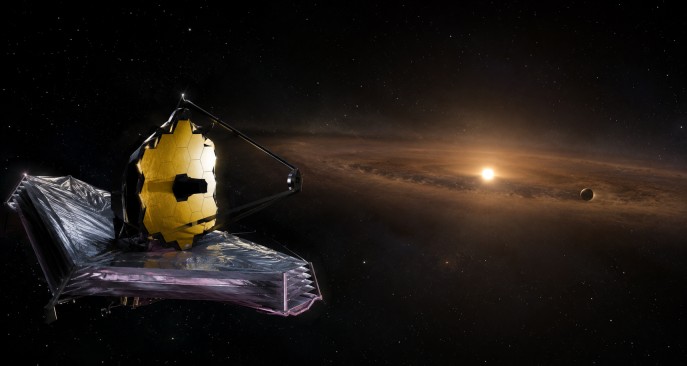
Astronomers have made a groundbreaking discovery using NASA’s James Webb Space Telescope, unveiling a hidden exoplanet, Beta Pictoris d, which adds to the planetary lineup orbiting the nearby star Beta Pictoris. This newly identified giant planet marks the third known in this well-explored system, and its detection came through an innovative approach, differing from the conventional direct imaging methods used for the other two planets.
Beta Pictoris d was discovered by identifying the distinctive chemical signature of its atmosphere, made possible with Webb’s Near-Infrared Spectrograph (NIRSpec). This serendipitous find occurred as scientists were conducting studies on another planet within the same system, showcasing an unexpected yet significant advancement in exoplanetary research.
By analyzing the atmospheric composition and motion of Beta Pictoris d, researchers confirmed its status as a giant planet. The presence of carbon monoxide, water vapor, and methane was detected, indicating its existence within the system’s bright debris disk, which had previously obscured it from standard imaging techniques.
Located approximately 63 light-years from Earth, the Beta Pictoris system is around 23 million years old, providing a vital framework for understanding planetary formation and evolution. Beta Pictoris d is estimated to have at least twice the mass of Jupiter and resides at a distance from its star comparable to that of Neptune in our solar system.
This discovery marks the inaugural instance of an exoplanet being identified primarily through moderate-resolution spectroscopy. It introduces a promising new method for detecting planets concealed within dusty environments, potentially enhancing future exoplanet searches throughout the Milky Way.