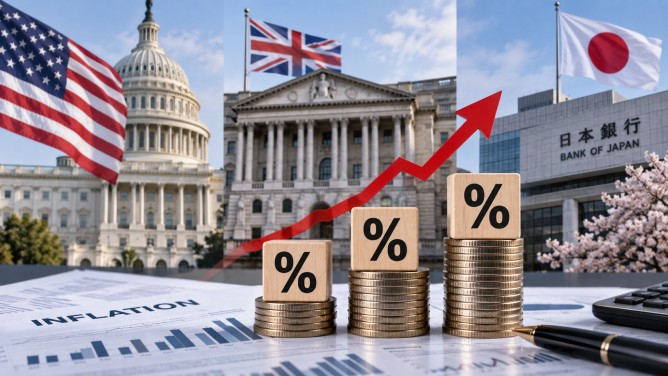
Central banks in the United States, United Kingdom, and Japan are gearing up to announce their latest monetary policy decisions this week, with surging inflation and rising energy prices taking center stage. The Federal Reserve in particular is under scrutiny as escalating oil prices threaten to push U.S. inflation further above the central bank’s 2% target. Recent tensions involving Iran and disruptions around the Strait of Hormuz have contributed to the renewed spike in energy costs.
In the U.S., inflation remains at a stubborn 3.4% annually, significantly overshooting the Federal Reserve’s target. Fed Chair Kevin Warsh has signaled that further action may be necessary if inflation does not continue to move towards the desired level. Despite President Donald Trump’s repeated calls for lower interest rates, the Federal Reserve is expected to carefully consider inflation risks before making any decisions.
Across the Atlantic, the Bank of England is anticipated to maintain its interest rate at 3.75% during its upcoming meeting. However, stronger-than-expected economic growth coupled with renewed pressures from energy prices have heightened concerns that inflation could persist at elevated levels. Some members of the Bank’s Monetary Policy Committee have already advocated for higher rates, suggesting that the committee might adopt a more hawkish approach even if rates remain stable.
Meanwhile, Japan’s central bank is also preparing for a potentially significant rate decision. The Bank of Japan is widely anticipated to raise its policy rate by 0.25 percentage points to 1.25%, marking the highest level in more than thirty years. This expected increase follows measures by Japanese and U.S. authorities to bolster the yen, which has recently strengthened.
The European Central Bank has already taken action by raising interest rates, attributing the decision to persistent inflationary pressures partly stemming from the Middle East conflict. With oil prices remaining high and global bond markets experiencing renewed volatility, investors will be watching closely this week for indications of how major central banks intend to balance the risks of inflation against economic growth.