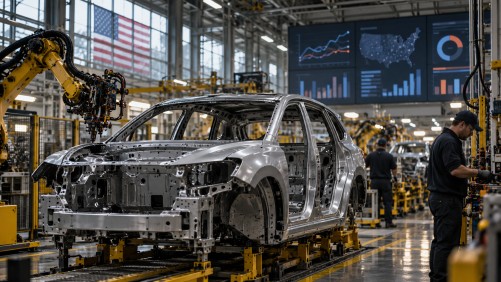
Uncertainty in U.S. electric vehicle (EV) policies is causing challenges for automakers, leading to concerns about the competitiveness of the American automotive industry. The U.S. government has implemented tariffs surpassing 100% on Chinese electric vehicles and imposed restrictions on automotive software and hardware linked to China, citing trade and data security concerns. However, experts argue that these protectionist measures may not suffice to bolster domestic manufacturers in the absence of a cohesive long-term industrial strategy.
Under President Donald Trump, modifications to government incentives and fuel economy standards have contributed to the uncertainty facing automakers, particularly as they plan investments that may take five to ten years to yield returns. As a result, some U.S. companies have scaled back expansion plans, delayed the development of new EV platforms, or reconsidered production targets.
Chinese manufacturers, too, face challenges entering the U.S. market due to policy uncertainty. BYD, a major Chinese automaker, has stated that it does not plan to sell passenger vehicles in the U.S. under the current conditions. Despite these hurdles, the U.S. market remains attractive for affordable electric vehicles, as Chinese companies have made significant strides in battery technology and cost-efficient production, potentially opening doors for future U.S.-China trade negotiations.
President Trump has suggested that Chinese automakers could operate in the U.S. if they set up factories and generate local jobs. Nonetheless, several American automotive industry groups have urged the administration to maintain restrictions on Chinese manufacturers. Some U.S. companies are already exploring selective collaborations with Chinese firms. For instance, Ford is partnering with Chinese battery manufacturer CATL on a Michigan battery facility where CATL provides technology and related services.
Analysts predict that broad restrictions on Chinese automakers are likely to persist, although selective partnerships in battery technology and manufacturing could continue where mutual commercial benefits exist.